
You're on your way!
You're being directed to a third-party site to get a quote.
Since 2011, we've helped more than 5 million visitors understand Medicare coverage.
By shopping with third-party insurance agencies, you may be contacted by a licensed insurance agent from an independent agency that is not connected with or endorsed by the federal Medicare program.
These agents/agencies may not offer every plan available in your area. Please contact Medicare.gov or 1-800-Medicare to get information on all options available.
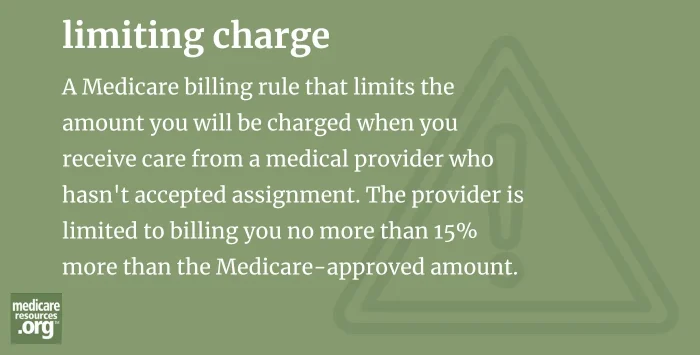
When you receive care from a health care service provider who doesn’t accept Medicare for your treatment but hasn’t entirely opted out of Medicare, the most you can be charged, under federal law, is 15 percent over the amount that Medicare will pay the doctor for that service (in addition to your normal Medicare out-of-pocket costs). And non-participating providers are paid a little less by Medicare — 95 percent of the normal reimbursement amount — so the additional 15 percent charge is based on that amount, rather than the normal reimbursement amount.
This cap on how much you can be charged is called the limiting charge. Limiting charges do not apply to equipment or medical supplies.
Most doctors do accept Medicare’s payment as payment in full (ie, they are participating providers), which means that the limiting charge doesn’t apply to them. Instead, you’ll just pay your normal Medicare deductible and coinsurance, and the doctor will not be able to bill you for any additional amount above and beyond what Medicare pays.
The limiting charge does not apply to providers who have opted out of Medicare altogether. In that case, the patient is responsible for the entire bill, and there’s no limit on how much the provider can charge. Very few doctors — an estimated 1 percent nationwide — have opted out of Medicare, but among some specialties the opt-out rate is much higher: 42 percent of psychiatrists have opted out of Medicare.

Q: What does it mean if your doctor doesn’t accept assignment? A: If your doctor doesn't "accept assignment," (ie, is a non-participating provider) it means he or she might see Medicare patients but wants to be paid more than the amount that Medicare is willing to pay. As a result, you may end up paying the difference between what Medicare will pay and what your provider charges — up to 15 percent above the amount that participating providers are paid by Medicare.

Medicare provides broad coverage but doesn't cover everything. Original Medicare, for example, does not cover routine dental care, dentures, routine eye care, corrective lenses, dentures, hearing aids, or long-term nursing home care.
Q: What does it mean if your doctor doesn’t accept assignment? A: If your doctor doesn't "accept assignment," (ie, is a non-participating provider) it means he or she might see Medicare patients but wants to be paid more than the amount that Medicare is willing to pay. As a result, you may end up paying the difference between what Medicare will pay and what your provider charges — up to 15 percent above the amount that participating providers are paid by Medicare.
Medicare provides broad coverage but doesn't cover everything. Original Medicare, for example, does not cover routine dental care, dentures, routine eye care, corrective lenses, dentures, hearing aids, or long-term nursing home care.

