
You're on your way!
You're being directed to a third-party site to get a quote.
Since 2011, we've helped more than 5 million visitors understand Medicare coverage.
By shopping with third-party insurance agencies, you may be contacted by a licensed insurance agent from an independent agency that is not connected with or endorsed by the federal Medicare program.
These agents/agencies may not offer every plan available in your area. Please contact Medicare.gov or 1-800-Medicare to get information on all options available.
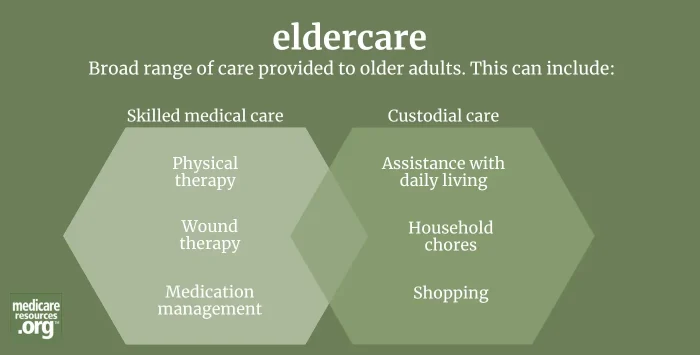
Eldercare refers to a broad range of care provided to older adults. This can include skilled medical care, such as physical therapy or wound care. But it also encompasses custodial care, which assists with activities of daily living as well as activities like shopping and household chores.11
Eldercare can be provided in the person’s home, at an adult day care center, or at a senior living community. Depending on the person’s needs, eldercare can also include the services provided in an assisted living facility, nursing home, memory care facility, or hospice program.2
Depending on the eldercare that’s needed, it can be provided by family members, hired in-home help, employees in a facility that offers assistance with ADLs, or by skilled medical providers in a hospital, clinic, office, or in-home setting.
The medically necessary skilled medical care received by an older adult is generally covered by health insurance (Medicare, for most Americans over 65).
But custodial care is not covered by Medicare unless it’s being provided in conjunction with skilled medical care such as physical therapy.
Medicaid does cover custodial care, for older adults with low income and asset levels.

Social Security is an income benefit for retirees who have worked and paid Social Security taxes for at least 10 years. Medicare provides health insurance coverage for anyone 65 or older who has worked for at least 10 years.
Social Security is an income benefit for retirees who have worked and paid Social Security taxes for at least 10 years. Medicare provides health insurance coverage for anyone 65 or older who has worked for at least 10 years.
Footnotes

