
You're on your way!
You're being directed to a third-party site to get a quote.
Since 2011, we've helped more than 5 million visitors understand Medicare coverage.
By shopping with third-party insurance agencies, you may be contacted by a licensed insurance agent from an independent agency that is not connected with or endorsed by the federal Medicare program.
These agents/agencies may not offer every plan available in your area. Please contact Medicare.gov or 1-800-Medicare to get information on all options available.
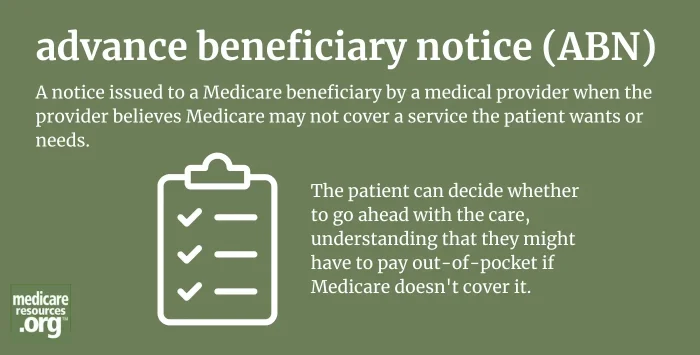
An advanced beneficiary notice (ABN) – also called a “waiver of liability” – is a notice that Medicare providers and suppliers must give to an Original Medicare enrollee before providing a medical service, if the provider believes that Medicare will not cover the service.1
ABNs do not have to be provided for care that’s never covered by Original Medicare, such as routine dental and vision care, hearing aids, or custodial long-term care. Instead, ABNs are used for care that can be covered by Medicare, but that the medical provider believes will not be covered in the patient’s situation.2
If your doctor or medical supplier gives you an ABN, it will include the reason the provider believes that Medicare won’t cover the service. You can decide to go ahead with the care in question, but the ABN lets you know that you may be responsible for the cost, since Medicare may deny the claim. You can still ask the provider to submit the claim to Medicare, and Medicare may cover it. If not, however, you’ll have to pay for the care yourself.

If your income is high or very low – or you're feeling lucky – you might be able to rely on traditional Medicare. Here's why most people don't.

Sometimes called “traditional Medicare,” Original Medicare is the fee-for-service program in which the government pays directly for healthcare costs that beneficiaries incur.
If your income is high or very low – or you're feeling lucky – you might be able to rely on traditional Medicare. Here's why most people don't.
Sometimes called “traditional Medicare,” Original Medicare is the fee-for-service program in which the government pays directly for healthcare costs that beneficiaries incur.
Footnotes

