
You're on your way!
You're being directed to a third-party site to get a quote.
Since 2011, we've helped more than 5 million visitors understand Medicare coverage.
By shopping with third-party insurance agencies, you may be contacted by a licensed insurance agent from an independent agency that is not connected with or endorsed by the federal Medicare program.
These agents/agencies may not offer every plan available in your area. Please contact Medicare.gov or 1-800-Medicare to get information on all options available.
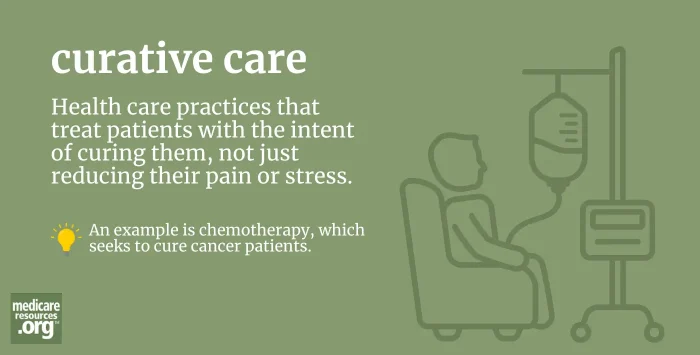
Curative care refers to health care practices that treat patients with the intent of curing them, not just reducing their pain or stress. An example is chemotherapy, which seeks to cure cancer patients.
The issue of curative care comes up when a patient has a terminal illness and is considering hospice care. Medicare covers hospice care, but a patient who has switched to Medicare’s hospice benefit will only have palliative care coverage for their terminal illness — curative care would not be covered. So a patient with terminal cancer can opt for Medicare’s hospice benefit, but would have to cease chemotherapy and instead receive care designed to provide comfort and alleviate pain.
But that doesn’t mean they won’t have coverage for any curative care. If they experience a medical problem that’s not related to the terminal illness, Medicare will cover curative care for that issue, subject to the applicable deductible and/or coinsurance.
And Medicare beneficiaries have the option to stop their hospice benefit at any point and return to regular Medicare coverage. So if a patient decides that they’d rather continue to seek curative care instead of palliative care, they have that choice.

The in-home care that Medicare will cover depends on the type of care involved, and whether it's truly medical in nature.

The good news is that while Medicare’s role in long-term care is complicated, you can head off much of the headache that comes with the financial burden of long-term care by understanding some basic concepts.

Medicare will cover the cost of a fall risk assessment to determine whether an enrollee is at a low, medium or high risk of falling.

Considering a change to your Medicare coverage? Consider these 10 factors when choosing between Medicare Advantage, Medigap, and Part D coverage.
The in-home care that Medicare will cover depends on the type of care involved, and whether it's truly medical in nature.
The good news is that while Medicare’s role in long-term care is complicated, you can head off much of the headache that comes with the financial burden of long-term care by understanding some basic concepts.
Medicare will cover the cost of a fall risk assessment to determine whether an enrollee is at a low, medium or high risk of falling.
Considering a change to your Medicare coverage? Consider these 10 factors when choosing between Medicare Advantage, Medigap, and Part D coverage.

