
You're on your way!
You're being directed to a third-party site to get a quote.
Since 2011, we've helped more than 5 million visitors understand Medicare coverage.
By shopping with third-party insurance agencies, you may be contacted by a licensed insurance agent from an independent agency that is not connected with or endorsed by the federal Medicare program.
These agents/agencies may not offer every plan available in your area. Please contact Medicare.gov or 1-800-Medicare to get information on all options available.
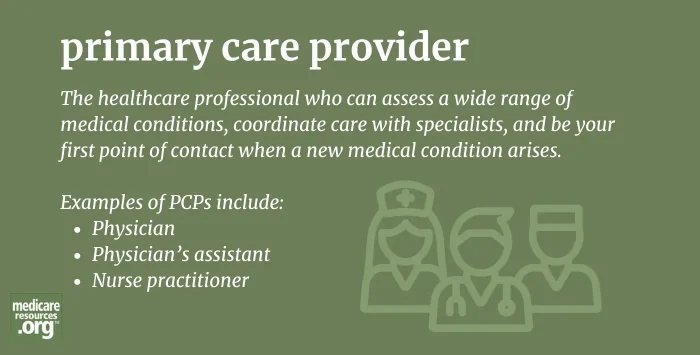
Your primary care provider (PCP) is the medical provider (usually a physician, physician’s assistant, or nurse practitioner) who can assess a wide range of medical conditions, coordinate care with specialists, and be your first point of contact when a new medical condition arises.
If you have a Medicare Advantage plan, the plan may require you to get a referral from your PCP before you can see a specialist. For these plans, a PCP is essential and your plan will assign one to you if you don’t select your own. Referrals are not required by Medicare Advantage PPOs (preferred provider organizations) or Original Medicare,1 but many enrollees still choose to have a trusted PCP for their primary care and care coordination needs.

Medicare covers a number of preventive screening services that make early diagnosis and treatment possible. What’s more, many beneficiaries can receive these screenings at low cost or no cost thanks to the Affordable Care Act, which eliminated cost sharing for a long list of Medicare preventive services.

Q: Will my doctors accept my Medicare card? A: Q: Will all doctors accept my Medicare coverage? A: The answer depends on what type of Medicare coverage you have, and whether you’re already a current patient.
Medicare covers a number of preventive screening services that make early diagnosis and treatment possible. What’s more, many beneficiaries can receive these screenings at low cost or no cost thanks to the Affordable Care Act, which eliminated cost sharing for a long list of Medicare preventive services.
Q: Will my doctors accept my Medicare card? A: Q: Will all doctors accept my Medicare coverage? A: The answer depends on what type of Medicare coverage you have, and whether you’re already a current patient.
Footnotes

