
You're on your way!
You're being directed to a third-party site to get a quote.
Since 2011, we've helped more than 5 million visitors understand Medicare coverage.
By shopping with third-party insurance agencies, you may be contacted by a licensed insurance agent from an independent agency that is not connected with or endorsed by the federal Medicare program.
These agents/agencies may not offer every plan available in your area. Please contact Medicare.gov or 1-800-Medicare to get information on all options available.
Although Medicare does not cover custodial long-term care services, Medicaid does. Medicaid is the primary payer for more than six out of ten nursing home residents in the U.S.1
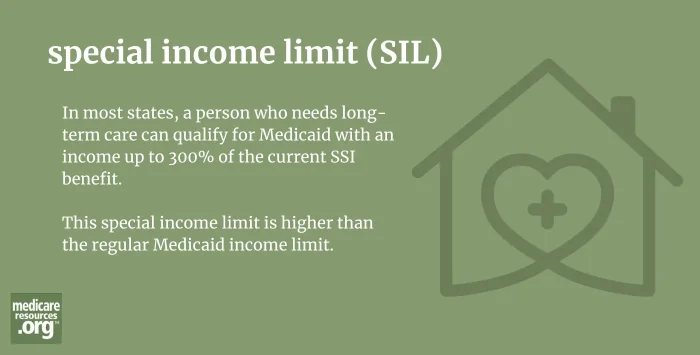
Due to the high cost of long-term care, most states have a “special income limit” for Medicaid long-term care benefits that is higher than the income limit for other Medicaid programs, although they generally use the same low asset/resource limit that applies to other Medicaid enrollees whose eligibility is based on both income and assets.2
As of 2025, the special income limit is used in 41 states to determine eligibility for Medicaid nursing home benefits and long-term in-home care programs.
The special income limit is set at 300% of the Supplemental Security Income (SSI) payment amount. In 2025, that amounts to $2,901 a month.2
The SIL that’s used to determine eligibility for Medicaid long-term care benefits is higher than the income limit for other Medicaid benefits for aged and disabled individuals. In most states, the income limit for aged/disabled Medicaid (when long-term care isn’t needed) usually isn’t more than the poverty line, or a monthly income of $1,304 for individuals and $1,762 for a couple.2
Using a SIL for Medicaid nursing home benefits does not mean enrollees can keep all of their income below this limit – because most of it must be paid toward their care. But some states allow HCBS recipients to keep all of their income up to the SIL.

Howard Gleckman, one of the nation’s leading experts on family caregiving and long-term care and author of Caring for our Parents, talks with Harold Pollack about the nation's looming national disability crisis.

People with Medicare and Medicaid are known as dual eligibles – and account for about 20 percent of Medicare beneficiaries (12.1 million people). Learn how that status affects your coverage.
Howard Gleckman, one of the nation’s leading experts on family caregiving and long-term care and author of Caring for our Parents, talks with Harold Pollack about the nation's looming national disability crisis.
People with Medicare and Medicaid are known as dual eligibles – and account for about 20 percent of Medicare beneficiaries (12.1 million people). Learn how that status affects your coverage.
Footnotes

