
You're on your way!
You're being directed to a third-party site to get a quote.
Since 2011, we've helped more than 5 million visitors understand Medicare coverage.
By shopping with third-party insurance agencies, you may be contacted by a licensed insurance agent from an independent agency that is not connected with or endorsed by the federal Medicare program.
These agents/agencies may not offer every plan available in your area. Please contact Medicare.gov or 1-800-Medicare to get information on all options available.

The Specified Low-Income Medicare Beneficiary (SLMB) program is a Medicare Savings Program (MSP) that pays for an enrollee’s Medicare Part B premiums. MSPs are federal programs that are administered by Medicaid in each state.1
The SLMB program is available to Medicare beneficiaries with low incomes and low asset/resource levels. The specific details are adjusted annually.
In 2025, the SLMB program is available to a single Medicare beneficiary with an income up to $1,585 and to a married couple with an income up to $2,135 (higher in Alaska and Hawaii, and higher in some other states).
In addition, a single individual’s assets/resource total in most states must not exceed $9,660 in 2025, and the asset/resource limit for a married couple is $14,470.1
Unlike the Qualified Individual (QI) program, which is another MSP that has higher income limits (but the same asset limits) and that also pays Part B premiums, people enrolled in SLMB do not have to reapply each year.2
As of 2025, the Medicare Part B premium for most enrollees is $185/month.3 SLMB enrollees no longer have this amount deducted from their Social Security benefit, which boosts their Social Security checks by a total of $2,220 in 2025.
Individuals who are approved for SLMB can receive three months of retroactive benefits.4
It can take two to three months between being approved for MSP benefits and the time Part B premiums are no longer deducted from Social Security income. Applicants should receive a one-time deposit for premiums that were withheld after they were enrolled in the program, and a payment for their retroactive benefits.
Unlike the Qualified Medicare Beneficiary (QMB) program, SLMB does not pay for Parts A and B cost sharing (e.g. deductibles, co-pays and coinsurance) or for Part A premiums (if an enrollee owes them).
But SLMB enrollees automatically receive Extra Help – a federal program that lowers premiums and out-of-pocket costs for Medicare Part D prescription drug coverage.1

Medicare Savings Programs (MSP) can pay Medicare Part A and Part B premiums, deductibles, copays, and coinsurance for enrollees with limited income and limited assets.
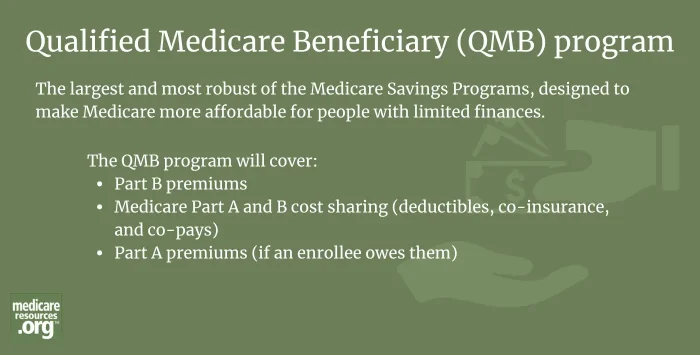
Some Medicare beneficiaries struggle to pay for Medicare premiums and cost sharing even though their incomes are too high to qualify for full Medicaid benefits. A group of Medicaid-administered programs – Medicare Savings Programs (MSPs) – pay for Part B premiums for these enrollees. The most commonly enrolled in MSPs are the Qualified Medicare Beneficiary (QMB) program, Specified Low-Income Medicare Beneficiary (SLMB) program, and Qualified Individuals (QI) program.

The Qualified Individuals (QI) program is a Medicare Savings Program (MSP) that pays for an enrollee’s Medicare Part B premiums. MSPs are federal programs that are administered by Medicaid in each state.
Medicare Savings Programs (MSP) can pay Medicare Part A and Part B premiums, deductibles, copays, and coinsurance for enrollees with limited income and limited assets.
Some Medicare beneficiaries struggle to pay for Medicare premiums and cost sharing even though their incomes are too high to qualify for full Medicaid benefits. A group of Medicaid-administered programs – Medicare Savings Programs (MSPs) – pay for Part B premiums for these enrollees. The most commonly enrolled in MSPs are the Qualified Medicare Beneficiary (QMB) program, Specified Low-Income Medicare Beneficiary (SLMB) program, and Qualified Individuals (QI) program.
The Qualified Individuals (QI) program is a Medicare Savings Program (MSP) that pays for an enrollee’s Medicare Part B premiums. MSPs are federal programs that are administered by Medicaid in each state.
Footnotes

