
You're on your way!
You're being directed to a third-party site to get a quote.
Since 2011, we've helped more than 5 million visitors understand Medicare coverage.
By shopping with third-party insurance agencies, you may be contacted by a licensed insurance agent from an independent agency that is not connected with or endorsed by the federal Medicare program.
These agents/agencies may not offer every plan available in your area. Please contact Medicare.gov or 1-800-Medicare to get information on all options available.

Yes, your income can affect your premiums for Medicare Part B and Medicare Part D. People with high incomes pay higher premiums for both of these parts of Medicare. The income threshold for premium surcharges is indexed for inflation each year. In 2026, the threshold is $109,000 for a single individual, and $218,000 for a married couple.1
Most people do not pay any premium for Medicare Part A,1 but even for those who do, there is no income-related surcharge, so Part A premiums are not affected by income.
Medicare beneficiaries who earn over $109,000 a year1 and who are enrolled in Medicare Part B and/or Medicare Part D – pay the income-related monthly adjusted amount (IRMAA), which is a surcharge added to the Part B and Part D premiums.
Since 2007, high-income Medicare enrollees have been required to pay the IRMAA surcharge for Medicare Part B coverage. An IRMAA surcharge for Medicare Part D premiums took effect in 2011.2
For Medicare beneficiaries who receive Social Security retirement benefits, the premium for Part B is deducted from their Social Security check. This is true regardless of whether the person is subject to the IRMAA surcharge. But the “hold harmless” provision that prevents Social Security checks from decreasing from one year to the next does not apply to people who pay the IRMAA surcharge.
(The “hold harmless” provision has not been widely applicable in recent years, due to average Social Security cost-of-living adjustments (COLA) being larger than Part B premium increases. For 2026, the average Social Security COLA amounted to $56/month,3 while the standard Part B premium increase was $17.90/month.1 So the hold harmless provision continues to be non-applicable in nearly all cases.)
Most Medicare beneficiaries do not pay IRMAA surcharges. According to the Medicare Trustees Report, about 5.1 million Medicare beneficiaries paid Part B IRMAA surcharges in 2025,4 amounting to about 7% of the 69 million total enrollees.5 And about 4.4 million beneficiaries paid IRMAA surcharges for their Part D prescription drug coverage.6 (The IRMAA income thresholds are the same for both Part B and Part D, but more beneficiaries have Part B than have Part D.5)
When people talk about “income limits” with regard to Medicare, they could be referring to the threshold where IRMAA surcharges start to apply for those on the higher end of the income spectrum. (Above a certain income limit, you’ll be subject to IRMAA, but below it, you won’t.)
But they could also be referring to the income thresholds that apply to Medicare Savings Programs and dual eligibility for Medicare and full Medicaid, for those on the lower end of the income spectrum. (Note that on the lower end, eligibility rules also include asset limits, in addition to income limits.)
So you’d need to know the context to determine which program is being discussed: Is it an upper income limit, below which a person has access to certain financial assistance with their coverage? Or are they referring to the highest income a person can have and not be subject to paying additional premiums for their Medicare coverage?
IRMAA is based on your income tax returns two years prior. This means that for your 2026 Medicare premiums, your 2024 income tax return is used to determine whether you’re subject to IRMAA. This is because the 2024 tax return is the most recent one the government has on file before the start of the 2026 coverage year.
IRMAA applicability and amounts are recalculated annually.7 The IRMAA surcharge will be added to your 2026 premiums if your 2024 income was over $109,000 (or $218,000 if you’re married).1 You will receive notice from the Social Security Administration to inform you if you are being assessed IRMAA. But as discussed below, there’s an appeals process if your financial situation has changed.
For those who are curious about how the inflation indexing works in terms of determining what income level counts as “high” each year, Harry Sit, of The Finance Buff, explains how it works. The indexing is based on the percentage by which the average of the Consumer Price Index for Urban Consumers (CPI-U) for the 12-month period ending in the most recent August exceeds the average of the 12-month period that preceded that. You can replicate the calculations using CPI-U data from this page (select the first box under “Price Indexes”).
The income used to determine IRMAA is a form of Modified Adjusted Gross Income (MAGI), but it’s specific to Medicare. The Modified Adjusted Gross Income may differ from your Adjusted Gross Income, because some people have additional income sources that must be added to their AGI to determine their IRMAA-specific MAGI.
It’s important to understand that MAGI for calculating IRMAA8 isn’t the same as the MAGI that you might be accustomed to for non-healthcare purposes, nor is it exactly the same as MAGI for calculating premium tax credits and Medicaid/CHIP eligibility under the Affordable Care Act.
There have been a few recent changes that affect high-income Medicare beneficiaries:
Here are the Part B IRMAA premiums for 20261 (based on 2024 income tax returns; the applicable premium is shown on the right. For incomes that are subject to IRMAA, the premium shown includes the IRMAA surcharge).
| Part B IRMAA premiums (2026) | ||
|---|---|---|
| Individual | Couple | Monthly Premium |
| $109,000 or less | $218,000 or less | $202.90 (no IRMAA) |
| > $109,000 – $137,000 | > $218,000 – $274,000 | $284.10 |
| > $137,000 – $171,000 | > $274,000 -$342,000 | $405.80 |
| > $171,000 – $205,000 | > $342,000 – $410,000 | $527.50 |
| > $205,000 – $500,000 | > $410,000 – $750,000 | $649.20 |
| Greater than $500,000 | Greater than $750,000 | $689.90 |
Source: Centers for Medicare & Medicaid Services1
(Note that since 2023, people who have had kidney transplants have lifetime access to Medicare Part B coverage of immunosuppressive drugs;9 before 2023, this only lasted for three years post-transplant. There’s a separate set of IRMAA premiums for high-income beneficiaries who are enrolled in immunosuppressive drug coverage only; the high-income premiums for these enrollees range from about $203/month to about $608/month in 2026.1)
For Medicare Part D, the IRMAA amounts are added to the regular premium for the enrollee’s plan. Part D plans have varying prices, ranging from as little as $0 to more than $100 per month, depending on where you live and the plan you select.10 So the full amount, after the IRMAA surcharge, will depend on the plan.
Note that if you are a Medicare Advantage policy member and your plan includes prescription drug benefits (almost all Medicare Advantage plans have integrated Part D drug benefits),11 the Medicare Part B and Part D IRMAAs are both added to the plan premium (Medicare Advantage enrollees pay the Medicare Part B premium in addition to any premium charged by their Medicare Advantage plan; the Part B premium is deducted from their Social Security checks if they’re receiving Social Security, or paid directly to Medicare if they’re not).
The following income levels (based on 2024 tax returns) trigger the associated IRMAA surcharges for 2026 Part D coverage, which is added to the enrollee’s monthly Part D (or Medicare Advantage) plan premium:
| Part D IRMAA premium surcharge (2026) | ||
|---|---|---|
| Individual | Couple | Added to plan premium |
| $109,000 or less | $218,000 or less | $0 (no IRMAA) |
| > $109,000 – $137,000 | > $218,000 – $274,000 | $14.50 |
| > $137,000 – $171,000 | > $274,000 -$342,000 | $37.50 |
| > $171,000 – $205,000 | > $342,000 – $410,000 | $60.40 |
| > $205,000 – $500,000 | > $410,000 – $750,000 | $83.30 |
| Greater than $500,000 | Greater than $750,000 | $91.00 |
Source: Centers for Medicare & Medicaid Services1
You can appeal the IRMAA determination – filing for a redetermination – if you believe the calculation was erroneous. In addition, if you have had a life-changing event such as a loss of income or divorce, then you can refile or you can file for a redetermination using Form SSA-44. For example, if you were still working in 2024 but have since retired, your current income might be lower than the income that was reflected on your 2024 tax return. If that’s the case, you can file for a redetermination, instead of waiting for your tax returns to catch up.
If you do not agree with a redetermination, there is a formalized appeal process – the third level of appeal – technically called the Decision by Office of Medicare Hearings and Appeals (OMHA). (Note that this is a different procedure from the appeal or grievance procedure when you receive denials of service from Medicare Parts A, B, or D.)
The higher premiums for Medicare Part B took effect in 2007, under the Medicare Modernization Act. And for Medicare Part D, they took effect in 2011, under the Affordable Care Act. Medicare premiums cover only a small fraction of the cost of providing coverage, and the IRMAA rules were created to ensure that beneficiaries with the means to do so are required to pay a larger share of the cost of their coverage.2
Beneficiaries’ premiums only cover about 25% of the cost of Part B, and about 15% of the cost of Part D — and that’s with IRMAA surcharges in effect for beneficiaries with high incomes.12 Most of the cost of Medicare Part B and Part D is covered by general revenues, and the IRMAA surcharges help to spread that cost to beneficiaries who can afford to pay a larger share of the cost of their coverage.
Further complications were introduced under the SECURE Act (Setting Every Community Up for Retirement Enhancement Act of 2019), enacted in late 2019. The SECURE Act has a number of different features – such as allowing IRA contributions after age 70½ if you’re still earning an income – and it extended the minimum age that one must receive RMDs (Required Minimum Distributions) from 70½ to 72.
The SECURE Act 2.0, enacted in late 2022, further increased the age at which one must begin receiving RMDs to 73 starting in 2023. And it will increase to 75 by 2033.13
The reason this may be important is that it is possible that delaying receiving RMDs may also reduce IRMAA if your Modified Adjusted Gross Income is close to the limits stated in the tables above.
When people withdraw from qualified funds such as a 401(k), IRA, or 403(b), these funds are taxable once they are transferred to their individual checking, savings, or brokerage account (assuming the retirement account wasn’t a Roth).14 The amount distributed is added to your taxable income, so exercise caution when you’re receiving distributions from qualified funds. This additional income will increase your Modified Adjusted Gross Income, and may subject you to higher Medicare Part B and Medicare Part D premiums.
Further, non-qualified funds must also be tracked because of the way mutual funds’ capital gains and dividend distributions are made. At the end of every year, many mutual funds distribute capital gains or dividends to those with mutual fund holdings. As a result, people can unknowingly earn more income as a result of investments, and the result can be higher Medicare premiums.
The inverse is also true and now may be more applicable to you: realized capital losses can reduce your MAGI, and could potentially reduce your Medicare Part B and Part D premiums.
We recommend that you speak with a tax planner or financial advisor if you have questions about your specific circumstances, including investment income or your plans to withdraw money from your retirement accounts.
If your income exceeded $109,000 in 2024, your 2026 Medicare Part D and Part B premiums depend on your income. As you can see in the tables above, the additional premiums can be substantial.
Understanding how this works – including what counts as income as far as Medicare is concerned – is a key part of your financial planning. And since the government will base your premiums on your income from two years ago, you’ll also want to have a good understanding of how to appeal an IRMAA determination, in case you experience a life change that reduces your income.
Jae W. Oh is a nationally recognized Medicare expert, frequently quoted in the national press, including on USA Today, Dow Jones, CNBC, and Nasdaq.com, as well as on radio talk shows nationwide. His book, Maximize Your Medicare, is available in print and ebook formats. Jae has appeared as a speaker in front of libraries, companies, as part of college-sponsored programs. The Managing Principal of GH2 Benefits, LLC, Jae is a Certified Financial Planner, Chartered Life Underwriter, a Chartered Financial Consultant, and a licensed insurance producer in multiple states.

Some Medicare enrollees are able to avoid having to pay IRMAA – the income-related surcharge – through strategies that reduce their household income.

Q: What does Original Medicare cost the beneficiary? A: Medicare Part A (hospital insurance) is free for most seniors. If you or your spouse worked at least 10 years in a job where you paid Medicare taxes, you're eligible for free Medicare Part A when you turn 65. But Medicare Part B has a premium; most beneficiaries pay $185/month for Part B in 2025.
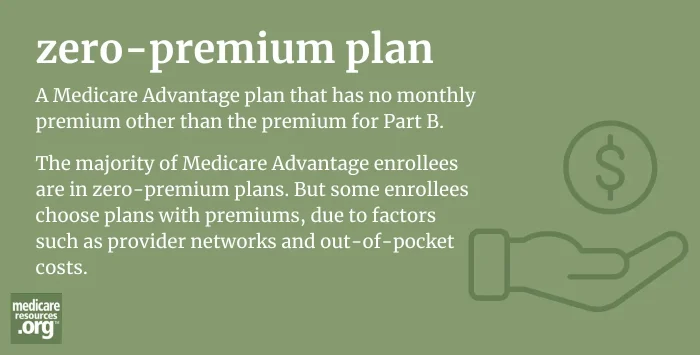
A zero-premium plan is a Medicare Advantage plan that has no monthly premium. In other words, you don't pay anything to the insurance company each month for your coverage.
Learn what Medicare Advantage (Medicare Part C) will cover, how much premiums cost, plan eligibility, enrollment windows and benefits.
Some Medicare enrollees are able to avoid having to pay IRMAA – the income-related surcharge – through strategies that reduce their household income.
Q: What does Original Medicare cost the beneficiary? A: Medicare Part A (hospital insurance) is free for most seniors. If you or your spouse worked at least 10 years in a job where you paid Medicare taxes, you're eligible for free Medicare Part A when you turn 65. But Medicare Part B has a premium; most beneficiaries pay $185/month for Part B in 2025.
A zero-premium plan is a Medicare Advantage plan that has no monthly premium. In other words, you don't pay anything to the insurance company each month for your coverage.
Learn what Medicare Advantage (Medicare Part C) will cover, how much premiums cost, plan eligibility, enrollment windows and benefits.
Footnotes

