
You're on your way!
You're being directed to a third-party site to get a quote.
Since 2011, we've helped more than 5 million visitors understand Medicare coverage.
By shopping with third-party insurance agencies, you may be contacted by a licensed insurance agent from an independent agency that is not connected with or endorsed by the federal Medicare program.
These agents/agencies may not offer every plan available in your area. Please contact Medicare.gov or 1-800-Medicare to get information on all options available.
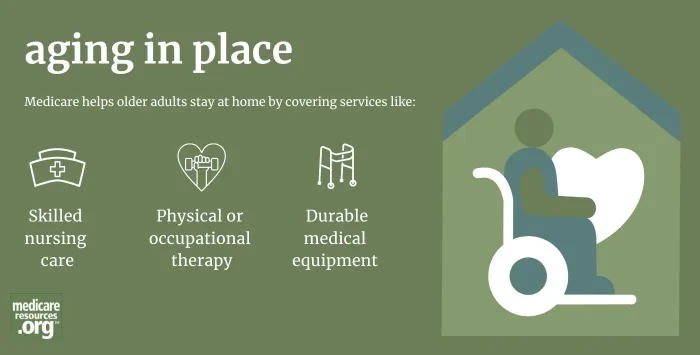
Aging in place refers to a decision individuals make to remain in their homes or their communities as they grow older instead of opting for relocation to long-term care facilities such as assisted living and nursing homes.
The decision to remain independent and at home will likely involve consideration of in-home care provided by caregivers who can assist individuals who might have difficulty with activities of daily living.
Medicare will cover certain medically necessary in-home care, such as skilled nursing care and various therapy services. Medicare can also cover certain custodial care (assistance with activities of daily living) provided at the same time as skilled medical care. This could include, for example, assistance with bathing or dressing that’s provided at the same time as in-home physical therapy.1
But Medicare will not cover custodial care by itself, regardless of whether the care is provided in-home or in a long-term care facility. Medicaid does cover custodial care for those who are eligible, but this generally only applies to people with low incomes and very low asset levels.2
The Programs of all-inclusive care for the elderly (PACE), which are available in most the majority of the states, can also cover services that make it possible for eligible seniors to remain in their homes instead of having to move into a nursing home.

The in-home care that Medicare will cover depends on the type of care involved, and whether it's truly medical in nature.

The good news is that while Medicare’s role in long-term care is complicated, you can head off much of the headache that comes with the financial burden of long-term care by understanding some basic concepts.

Medicare will cover the cost of a fall risk assessment to determine whether an enrollee is at a low, medium or high risk of falling.

Considering a change to your Medicare coverage? Consider these 10 factors when choosing between Medicare Advantage, Medigap, and Part D coverage.
The in-home care that Medicare will cover depends on the type of care involved, and whether it's truly medical in nature.
The good news is that while Medicare’s role in long-term care is complicated, you can head off much of the headache that comes with the financial burden of long-term care by understanding some basic concepts.
Medicare will cover the cost of a fall risk assessment to determine whether an enrollee is at a low, medium or high risk of falling.
Considering a change to your Medicare coverage? Consider these 10 factors when choosing between Medicare Advantage, Medigap, and Part D coverage.
Footnotes

