You're on your way!
You're being directed to a third-party site to get a quote.
Since 2011, we've helped more than 5 million visitors understand Medicare coverage.
By shopping with third-party insurance agencies, you may be contacted by a licensed insurance agent from an independent agency that is not connected with or endorsed by the federal Medicare program.
These agents/agencies may not offer every plan available in your area. Please contact Medicare.gov or 1-800-Medicare to get information on all options available.
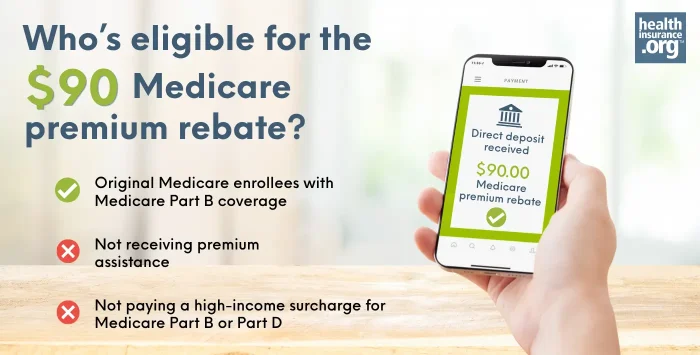
Nearly 21 million Medicare beneficiaries will receive a one-time $90 payment from the federal government in October 2026 to help offset the cost of their Medicare Part B premiums. But most Medicare beneficiaries won’t get the rebate.
In early October 2026, the White House announced that 20.8 million Medicare beneficiaries would receive a $90 Medicare Improvement Fund Premium Rebate.1
Here’s what you need to know about this rebate:
To be eligible for the $90 Medicare premium rebate, you must be:2
There are 70.6 million people enrolled in Medicare,5 but less than a third of them are eligible for the $90 rebate.2
Beneficiaries who are NOT eligible for the $90 premium rebate include:
Most eligible beneficiaries were expected to receive the rebate through direct deposit around October 8. However, if the government doesn’t have your direct deposit information on file and you’re eligible for the rebate payment, you’ll receive a paper check later in October. You do not need to apply for the rebate; it’s sent automatically if you’re eligible.2
If you believe you’re eligible for the $90 Medicare Improvement Fund Premium Rebate and you didn’t receive a direct deposit or paper check by October 15, 2026, you can contact the Social Security Administration at 1-800-772-1213.2
The $90 Medicare premium rebate and the Medicare Part B premium reduction are two separate things.
The $90 Medicare Improvement Fund Premium Rebate is a one-time payment, sent to nearly 21 million eligible Medicare Part B enrollees. The Medicare Part B premium reduction, which is sometimes called a “giveback,” helps some Medicare Advantage enrollees pay for some or all of their Part B premiums.
For 2026, about a quarter of Medicare Advantage plans offered Medicare Part B giveback.
The federal government has not issued specific guidance on the taxability of the $90 Medicare premium rebate. But since it is being treated as a Part B premium rebate (specifically a “$90 payment to offset October premium”),2 people who deduct their Medicare premiums on their taxes should consult with their tax advisor about accurately accounting for it.6
Medicare premiums are tax deductible for people who are self-employed, and also for people who itemize their deductions and are thus able to deduct total medical expenses – including premiums – that exceed 7.5% of their adjusted gross income.
The Medicare Improvement Fund is being used to pay the $90 Medicare premium rebate payments.2
Congress established this fund in 2008 to “make improvements under the original fee-for-service program,” and has changed the amount of money available to the fund numerous times over the years.7 Most recently, authorization for the fund stood at just over $2 billion.8
The $90 Medicare premium rebate amounts to about $1.9 billion in total spending, so it uses nearly all of the available funding. Although the Medicare Improvement Fund has existed since 2008, this is the first time that CMS has drawn money from it.9

Learn about the Medicare Part B giveback, how some Medicare Advantage plans reduce your Part B premium, and how to find plans with this cost-saving benefit.

Here's how to save money on premiums for Medicare Part B – which covers doctor visits, diagnostics, and preventive care.

Learn what Medicare Part B covers — from outpatient care and preventive services to durable medical equipment — and get the 2026 premium ($202.90/month), deductible ($283), high-income surcharges and enrollment rules.
Learn about the Medicare Part B giveback, how some Medicare Advantage plans reduce your Part B premium, and how to find plans with this cost-saving benefit.
Here's how to save money on premiums for Medicare Part B – which covers doctor visits, diagnostics, and preventive care.
Learn what Medicare Part B covers — from outpatient care and preventive services to durable medical equipment — and get the 2026 premium ($202.90/month), deductible ($283), high-income surcharges and enrollment rules.
Footnotes
