
You're on your way!
You're being directed to a third-party site to get a quote.
Since 2011, we've helped more than 5 million visitors understand Medicare coverage.
By shopping with third-party insurance agencies, you may be contacted by a licensed insurance agent from an independent agency that is not connected with or endorsed by the federal Medicare program.
These agents/agencies may not offer every plan available in your area. Please contact Medicare.gov or 1-800-Medicare to get information on all options available.
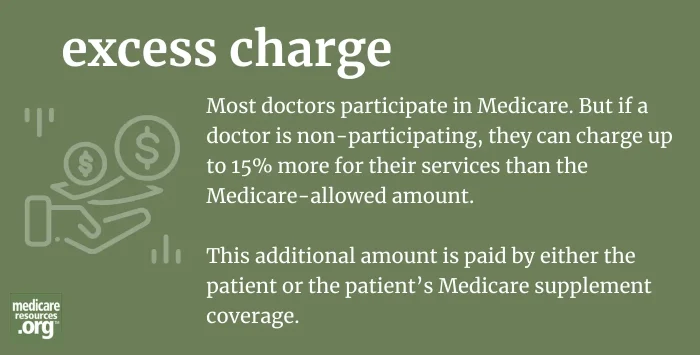
For an Original Medicare enrollee, the excess charge, also known as a “limiting charge,” is the difference between a doctor’s fee for service and what Medicare Part B has approved as payment for that service.
The excess charge only applies if the doctor doesn’t “accept assignment” with Medicare, but has not opted out of Medicare altogether. In other words, they’re a non-participating provider.1
This is rare however, as almost all providers who bill Medicare are participating providers. This means they agree to accept Medicare’s rates as payment in full and do not have any excess charges.2
When a non-participating provider bills Medicare, their approved amount is only 95% of what Medicare would approve for a participating provider (meaning a provider who does accept assignment, agreeing to accept Medicare’s normal approved amount as payment in full). That 95% is paid partially by Medicare, and partially by the patient in the form of coinsurance (or by the patient’s supplemental coverage, if they have it), assuming the patient has already met their Part B deductible for the year.
But then the non-participating provider is allowed to charge up to 15% more, on top of the amount that Medicare approves for the service. This additional amount is called an excess charge. It’s either paid by the patient or by the patient’s supplemental coverage (Medigap plans F and G cover Part B excess charges).3
Because Medicare pays non-participating providers less than participating providers, the excess charge amounts to less than 115% of the normal Medicare-approved amount.4
Some states prohibit non-participating providers from billing Medicare patients for excess charges, or limit the amount to something less than 15%.5

An overview of 2025 premiums and out-of-pocket costs for Original Medicare, Medicare Advantage, Medigap and Medicare Part D.

Learn what Medicare Part B covers — from outpatient care and preventive services to durable medical equipment — and get the 2026 premium ($202.90/month), deductible ($283), high-income surcharges and enrollment rules.
An overview of 2025 premiums and out-of-pocket costs for Original Medicare, Medicare Advantage, Medigap and Medicare Part D.
Learn what Medicare Part B covers — from outpatient care and preventive services to durable medical equipment — and get the 2026 premium ($202.90/month), deductible ($283), high-income surcharges and enrollment rules.
Footnotes

