You're on your way!
You're being directed to a third-party site to get a quote.
Since 2011, we've helped more than 5 million visitors understand Medicare coverage.
By shopping with third-party insurance agencies, you may be contacted by a licensed insurance agent from an independent agency that is not connected with or endorsed by the federal Medicare program.
These agents/agencies may not offer every plan available in your area. Please contact Medicare.gov or 1-800-Medicare to get information on all options available.
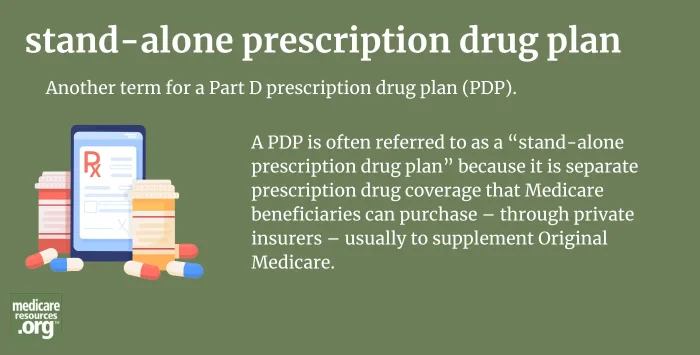
A stand-alone prescription drug plan is another term for a Medicare Part D prescription drug plan (PDP) that’s purchased on its own, rather than being integrated with a Medicare Advantage plan.
PDPs are offered by private health insurance companies, and must comply with various federal rules. In 2025, a total of 464 PDPs are available nationwide (the average beneficiary can select from between 12 and 16 plans, depending on where they live), although this is far lower than the peak of 1,866 PDPs that were available in 2007, when the program was new.1
The monthly premium that beneficiaries pay for PDPs varies considerably depending on the plan they select. Some plans have no premiums, while others have premiums of $100/month or more.1 Enrollees with high incomes pay a surcharge for both their Part D and Part B coverage.
Enrollees’ premiums only cover a small portion of the cost of PDP coverage, most of which is financed by the federal government.1
To enroll in a stand-alone Medicare Part D drug plan, a person must be enrolled in at least Medicare Part A or Part B.2
Most PDP enrollees have Original Medicare, although there are some types of Medicare Advantage plans under which a beneficiary can purchase a PDP if the Medicare Advantage plan doesn’t include prescription drug coverage.
To clarify, in most types of Medicare Advantage plans, enrollees cannot also purchase a separate PDP. But most Medicare Advantage plans already include Part D drug coverage.3
As of early 2025, there were 23.5 million Medicare beneficiaries enrolled in PDPs. Another 32.5 million were enrolled in Part D coverage integrated with a Medicare Advantage plan.4
Over the last several years, enrollment in PDPs has been declining, while enrollment in MAPDs (Medicare Advantage plans with integrated Part D coverage) has been increasing.1
Read our overview of Medicare Part D prescription drug coverage.
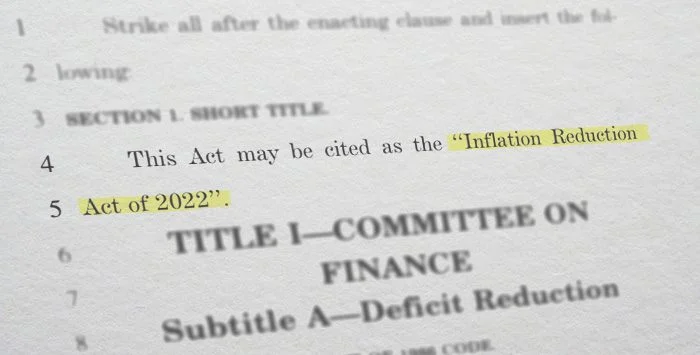
Beginning in 2023, a series of changes began to be phased in under the Inflation Reduction Act, designed to lower out-of-pocket costs, expand access to vaccines, and rein in drug price increases.

Prescription drugs – and drug coverage – can be less expensive if you're willing to do a little research and to reach out for help. Here are eight strategies that will empower you to take control of your drug coverage and your medication costs.

Learn how Medicare Part D prescription drug coverage works, what it pays for, how and when to enroll, how many people have Part D. and the potential penalty for late enrollment.
Beginning in 2023, a series of changes began to be phased in under the Inflation Reduction Act, designed to lower out-of-pocket costs, expand access to vaccines, and rein in drug price increases.
Prescription drugs – and drug coverage – can be less expensive if you're willing to do a little research and to reach out for help. Here are eight strategies that will empower you to take control of your drug coverage and your medication costs.
Learn how Medicare Part D prescription drug coverage works, what it pays for, how and when to enroll, how many people have Part D. and the potential penalty for late enrollment.
Footnotes

