
You're on your way!
You're being directed to a third-party site to get a quote.
Since 2011, we've helped more than 5 million visitors understand Medicare coverage.
By shopping with third-party insurance agencies, you may be contacted by a licensed insurance agent from an independent agency that is not connected with or endorsed by the federal Medicare program.
These agents/agencies may not offer every plan available in your area. Please contact Medicare.gov or 1-800-Medicare to get information on all options available.

Medicare Part A (hospital insurance) is premium-free for most enrollees. If you or your spouse worked at least 10 years in a job where you paid Medicare taxes, you’re eligible for free Medicare Part A when you turn 65. Almost all Medicare beneficiaries — 99% — receive Medicare Part A without having to pay a premium.1
Medicare A is also premium-free for people under 65 who have been on Social Security disability for at least two years, or who have end-stage renal disease or ALS.
Medicare Part B has a premium for all enrollees (unless you’re dual-eligible for Medicare and Medicaid, in which case the Part B premium can be paid by your state’s Medicaid program). The premiums are higher for those with high incomes (in 2026, that’s defined as at least an income of more than $109,000 for a single person, based on 2024 tax returns; the threshold is indexed annually).1
Medicare Parts A and B both have deductibles and coinsurance that are charged if and when the beneficiary receives medical services. Most people with Original Medicare also have supplemental coverage — either from an employer or retiree plan, Medicaid, or privately purchased Medigap plans — which help to pay some or all of the out-of-pocket deductible and coinsurance costs.2
Most Medicare beneficiaries also have private Medicare Part D coverage for prescription drugs, either as a stand-alone plan or as part of a Medicare Advantage plan. Employer-sponsored coverage for current employees or retirees can also provide supplemental drug coverage for Medicare beneficiaries.
If you purchase supplemental drug coverage and Medigap, the premiums for those two policies will be in addition to the Part B premiums (and if applicable, the Part A premiums).
Free for most enrollees, due to Medicare taxes paid by themselves or a spouse. But up to $565/month in 2026 if work history is insufficient.
$202.90/month for most enrollees in 2026, although high-income enrollees pay more.
$1,736 per benefit period (covers first 60 days of inpatient care and first 20 days in a skilled nursing facility)
$283
Inpatient days 0-60: $0 per day.
Inpatient days 61-90: $434 per day.
Inpatient days 91-150 (lifetime reserve days): $868 per day
N/A
Days 0-20: $0 per day.
Days 21-100: $217 per day
N/A
N/A
20% after deductible
*All statistics are from medicare.gov for 20263
Although most Medicare beneficiaries receive Part A with no premium, if you do have to pay for it, the premium in 2026 is $565 per month if you worked less than 7.5 years, and $311 per month if you worked between 7.5 and 10 years.4
If you’re hospitalized, Medicare Part A has a deductible of $1,736 in 20264 (per benefit period). There is also a copay amount that is charged on a per-day basis after a patient has spent 60 days in the hospital during a single benefit period. In 2026, it’s $434 per day for days 61-90. Each beneficiary has 60 “lifetime reserve days” which can be used if the person still needs to be hospitalized after 90 days in a single benefit period. In 2026, the lifetime reserve coinsurance is $868 per day.4 All Medigap plans cover these coinsurance charges, plus up to another 365 days of inpatient care after Medicare benefits are exhausted.5
(Medicare Advantage plans can have different plan designs in terms of cost-sharing, so the deductible and coinsurance for Medicare Part A isn’t the same as the out-of-pocket costs that a beneficiary pays if they’re hospitalized while enrolled in a Medicare Advantage plan.)
Medicare Part B has a standard monthly premium of $202.90 in 2026, for people who earn up to $109,000 a year1 ($218,000 for a married couple; note that this is based on income reflected on 2024 tax returns). The premiums are higher if your income exceeds that amount. If an enrollee receives care that’s covered under Medicare Part B, they’ll first pay an annual deductible, which is $283 in 2026.4
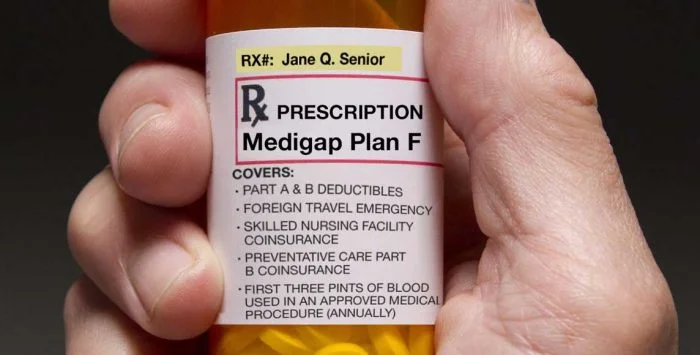
Some Medigap plans pay the Part B deductible. For people who become eligible for Medicare on or after January 1, 2020, Medigap plans that cover the Part B deductible are no longer available, but people who became eligible for Medicare before that date can continue to have coverage under Medigap Plans C or F, both of which cover the Part B deductible5 (these beneficiaries can keep those plans if they already have them, or they can apply for coverage under them if they want to change their plan, keeping in mind that medical underwriting is used in most states if you’re applying for a Medigap plan after your initial enrollment period ends).
(As noted above, Medicare Advantage plans can have different plan designs in terms of cost-sharing, so the out-of-pocket costs that an enrollee will pay for outpatient care will be different if they’re enrolled in a Medicare Advantage plan.)

Here's how to save money on premiums for Medicare Part B – which covers doctor visits, diagnostics, and preventive care.

If you're like most Medicare enrollees, you probably aren't planning to make any changes to your existing coverage for the coming year, but – like most beneficiaries – you should probably at least consider it during Medicare's open enrollment period. And if you have Medicare Advantage, you also have an opportunity to change your coverage between January and March each year.
Considering a change to your Medicare coverage? Consider these 10 factors when choosing between Medicare Advantage, Medigap, and Part D coverage.
Here's how to save money on premiums for Medicare Part B – which covers doctor visits, diagnostics, and preventive care.
If you're like most Medicare enrollees, you probably aren't planning to make any changes to your existing coverage for the coming year, but – like most beneficiaries – you should probably at least consider it during Medicare's open enrollment period. And if you have Medicare Advantage, you also have an opportunity to change your coverage between January and March each year.
Considering a change to your Medicare coverage? Consider these 10 factors when choosing between Medicare Advantage, Medigap, and Part D coverage.
Footnotes

