
You're on your way!
You're being directed to a third-party site to get a quote.
Since 2011, we've helped more than 5 million visitors understand Medicare coverage.
By shopping with third-party insurance agencies, you may be contacted by a licensed insurance agent from an independent agency that is not connected with or endorsed by the federal Medicare program.
These agents/agencies may not offer every plan available in your area. Please contact Medicare.gov or 1-800-Medicare to get information on all options available.

Inpatient coverage from hospital beds to hospice care
For millions of enrollees, Medicare Part A covers the large majority of hospitalization expenses. Most folks who are eligible for Medicare do not have to pay a premium for Medicare Part A,1 thanks to the payroll taxes they (or their spouse) paid during their working years.
Part A coverage – or “hospital insurance” – pays for a broad range of inpatient care in hospitals, skilled nursing facilities, and critical access hospitals. And, while it does not cover long-term custodial care, Medicare Part A does cover some home health care and hospice services.
The list of expenses covered by Medicare Part A includes:2
If you are already receiving Social Security or Railroad Retirement Board (RRB) benefits, the government automatically enrolls you in Medicare Part A at no cost when you reach age 65.6 Look for your Medicare card to automatically arrive in the mail three months prior to your 65th birthday (or the 25th month of a disability, as you become eligible for Medicare after two years of being disabled and receiving Social Security Disability benefits).
If you have ALS (amyotrophic lateral sclerosis, also called Lou Gehrig’s disease), you’ll get Part A automatically the month your Social Security disability benefits begin, however. If you’re close to 65 years old, but not getting Social Security or RRB benefits, you’ll need to sign up for Medicare. If you have End-Stage Renal Disease (ESRD) and want Medicare, you’ll need to sign up for it.
Regardless of age, individuals diagnosed with amyotrophic lateral sclerosis (ALS) receive their Medicare Part A card through the mail the month their disability benefits begin (and there is no longer a five-month waiting period for disability benefits to begin after an ALS diagnosis). People with end-stage renal disease (kidney failure) are also eligible for Medicare coverage, starting either the fourth month of dialysis or, if the patient enrolls in a home dialysis program, the first month of dialysis.7
Individuals eligible for Medicare because of their work history and age who are not automatically enrolled in Medicare Part A have a seven-month window of time to enroll, beginning three months prior to the month they turn 65 and continuing for three months after their birthday month. This is called the Initial Enrollment Period.
If you’re not eligible for premium-free Medicare Part A and you delay your enrollment until after Initial Enrollment Period, you’ll be subject to additional premiums for Part A and will likely need to wait until the General Enrollment Period to sign up.8 (Most people are eligible for premium-free Part A,9 but if you or your spouse haven’t paid at least ten years of payroll taxes, you’d have to pay for Medicare Part A. To qualify for premium-free Medicare based on your spouse’s work record, your spouse must be at least 62 years old.)7
Learn more about Medicare’s coverage of end-stage renal disease (ESRD) and ALS.
How much you pay for Medicare Part A coverage depends on your work history. If you or your spouse worked and paid into Medicare through payroll taxes for at least 40 quarters (10 or more years), you pay nothing each month for Medicare Part A. (If you’re qualifying based on your spouse’s work record, your spouse must be at least 62 years old.7 If not, you have to pay for Medicare Part A even if your spouse paid payroll taxes for 10+ years).
There are some requirements to be aware of in terms of the length of the marriage if you’re enrolling based on your spouse’s work history.10 Also, since the Defense of Marriage Act was ruled unconstitutional in 2013, the Social Security Administration has processed premium-free Medicare A enrollments based on the work history of enrollees’ same-sex spouses.11
If you or your spouse worked and paid into Medicare for between 7.5 and 10 years, you’ll pay $311 a month for Medicare Part A in 2026. If the work history was less than 7.5 years, the premium is $565 a month in 2026.12 These amounts generally increase each year, as was the case for 2026.13
If you are 65 and you or your spouse has paid Medicare taxes for at least 10 years, you don’t pay a premium for Part A.14
You may also not have to pay the premium:
You have been diagnosed with ALS and are eligible for Social Security Disability Insurance (SSDI). Medicare coverage begins as soon as your SSDI begins, and Medicare Part A has no premiums as long as you or your spouse (or parent, if you’re a dependent child) worked and paid Medicare taxes for at least 10 years.
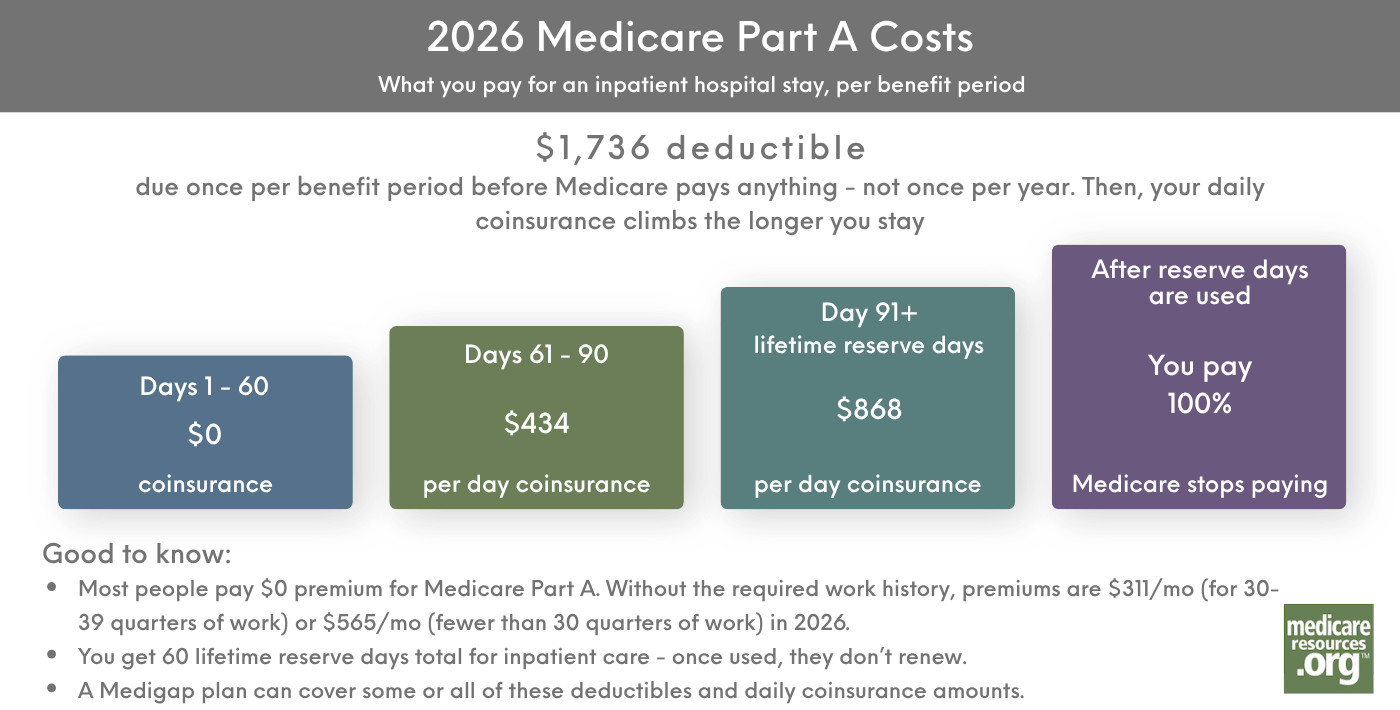
Medicare Part A pays the majority of the Medicare-approved charges for inpatient health care services. However, you must pay a deductible ($1,736 in 2026) 16 for each benefit period. Note that this isn’t the same as deductibles on most other types of health insurance, as the deductible is for each benefit period rather than each year.
And there are per diem copays that apply to extended hospital stays. If your hospitalization lasts more than 60 days in 2026, you’ll pay $434 per day for days 61 through 90, 16 in addition to the deductible you already paid for that benefit period (if you are discharged from the hospital before the 61st day, you only pay the deductible).
If you’re hospitalized for longer than 90 days, you have 60 lifetime reserve days that you can use – during those days, you’ll pay $868 per day in 2026. 16 Once the reserve days are used up, Medicare doesn’t pay any additional charges during that benefit period (a benefit period begins on the day you’re admitted to the hospital, and ends when you’ve been out of the hospital for 60 days).
It’s rare for beneficiaries to be hospitalized more than 60 days,17 but not unheard of – which is why a Medigap supplement can be an important addition to Original Medicare in retirement for some people, including those who don’t have supplemental coverage from an employer-sponsored plan or Medicaid to pay the costs Original Medicare doesn’t cover.
Medigap supplemental coverage may be important even for beneficiaries with more modest medical needs, as most of the available plans will cover some or all of the Medicare Part A deductible, as well as the per-day costs that would otherwise have to be paid for an extensive hospital stay.18 Medigap plans also pick up a large portion of the out-of-pocket costs that beneficiaries would otherwise have to pay for services covered by Medicare Part B.
Explore coverage options from a licensed agency!



You may be eligible to enroll in Medicare Part A at age 65, but some seniors decide to delay their enrollment. Here's why.

An overview of 2025 premiums and out-of-pocket costs for Original Medicare, Medicare Advantage, Medigap and Medicare Part D.

Learn how premiums, out-of-pocket costs and income-related surcharges are changing for 2026 Medicare coverage.

Eligibility for Medicare coverage depends on factors that include your work history, health status, and residency status. Check your eligibility today.

Learn how and when to enroll in Original Medicare, Medicare Advantage, Medigap, and Part D coverage. Get plan information and a free quote today.

Enrollment dates for Medicare are critical. Missing an enrollment date could cost you higher premiums down the line — or it could cost you coverage entirely.

Medicare beneficiaries need to know when their plan will be effective so they can avoid coverage gaps that could leave them without access to care they need.
You may be eligible to enroll in Medicare Part A at age 65, but some seniors decide to delay their enrollment. Here's why.
An overview of 2025 premiums and out-of-pocket costs for Original Medicare, Medicare Advantage, Medigap and Medicare Part D.
Learn how premiums, out-of-pocket costs and income-related surcharges are changing for 2026 Medicare coverage.
Eligibility for Medicare coverage depends on factors that include your work history, health status, and residency status. Check your eligibility today.
Learn how and when to enroll in Original Medicare, Medicare Advantage, Medigap, and Part D coverage. Get plan information and a free quote today.
Enrollment dates for Medicare are critical. Missing an enrollment date could cost you higher premiums down the line — or it could cost you coverage entirely.
Medicare beneficiaries need to know when their plan will be effective so they can avoid coverage gaps that could leave them without access to care they need.
Footnotes

