You're on your way!
You're being directed to a third-party site to get a quote.
Since 2011, we've helped more than 5 million visitors understand Medicare coverage.
By shopping with third-party insurance agencies, you may be contacted by a licensed insurance agent from an independent agency that is not connected with or endorsed by the federal Medicare program.
These agents/agencies may not offer every plan available in your area. Please contact Medicare.gov or 1-800-Medicare to get information on all options available.

A state-by-state guide to policies and regulations that affect financial assistance for Medicare enrollees.
Although Medicare provides comprehensive health coverage to millions of older and disabled Americans, it can still result in significant out-of-pocket expenses.1 And Medicare doesn’t cover custodial long-term care.
The good news is that Medicaid can provide assistance to Medicare beneficiaries with limited financial resources. Some Medicare beneficiaries are eligible for full Medicaid coverage in addition to their Medicare benefits, while others qualify for assistance with Medicare premiums and cost-sharing.
Because Medicaid is administered by each state, eligibility and benefits vary from one state to another. The pages in this section – including one for every state and the District of Columbia – are designed to help Medicare enrollees easily find the eligibility rules for programs and financial assistance in each state
You can start by choosing your state from the map below.
Here’s what’s covered in each state section:
Medicare Savings Programs (MSPs) are Medicaid-administered programs that cover Medicare premiums (and in some cases, out-of-pocket costs) for eligible enrollees. Each state offers a set of MSP programs, which include the Qualified Medicare Beneficiary (QMB), Specified Low-Income Medicare Beneficiary (SLMB) and Qualified Individuals (QI) programs. These programs all pay for Part B premiums. One MSP also pays for Medicare Part A and B cost sharing, and covers Part A premiums for enrollees who owe them.2
Receiving the MSP means Part B premiums are no longer deducted from an enrollee’s Social Security benefit, which results in an annual benefit increase of over $2,220 for 2025 (the Part B premium is adjusted annually; in 2025, it’s $185/month).1
Income limits: The income limits for MSPs vary depending on the program and the state. The QMB program is the most robust and has the lowest income limits ($1,325 for a single individual in most states as of 2025). The income limits are higher for the SLMB program, and higher still for the QI program, but still only $1,781 for a single individual in most states as of 2025. However, states can set higher income limits for these programs. Another MSP (which is less common than the others)3 is the Qualified Disabled Working Individuals (QDWI) program, which pays for Part A premiums for a small number of disabled enrollees who return to work.2
Asset limits: The asset/resource limit set by the federal government for QMB, SLMB, and QI is $9,660 for individuals and $14,470 for married couples as of 2025.2 Many states use the asset limit set by the federal government, but there is a trend of some states increasing or removing their limits.4
In every state, Medicaid is available to people with limited financial means who are aged (65 or older), blind, or disabled. This coverage is usually at least as comprehensive as benefits offered by private insurers, and can pay for cost sharing and services Medicare doesn’t cover (including vision and dental care in many states, some medical supplies, and nursing home care).
Medicaid for the aged, blind and disabled has different names in each state. It is sometimes called ABD Medicaid, community Medicaid, traditional Medicaid, or SSI-Related Medicaid.
ABD Medicaid pays after Medicare pays, for services covered by both programs (in other words, Medicare is primary and Medicaid is secondary).5 This usually leaves enrollees who are fully dual eligible – meaning they have both Medicare and full Medicaid benefits – with little or no out-of-pocket expenses.
Medicare beneficiaries don’t have access to dental or vision care through Original Medicare, although most Medicare Advantage plans provide at least some level of coverage for those services.6 In many states, Medicaid provides comprehensive dental and vision coverage, and may also cover costly items like dentures (coverage specifics vary considerably by state).
It’s important to note that ABD Medicaid differs from Medicaid expansion. They serve different populations and have different eligibility rules. Medicaid expansion is for adults under the age of 65, and eligibility is based only on income (starting in 2027, Medicaid expansion will have a work requirement, as a result of the “Big Beautiful Bill” that was enacted in 2025).
But once a person turns 65, they’re no longer eligible under Medicaid expansion rules. ABD Medicaid has both income and asset limits. So while a person with low income but significant assets can qualify for Medicaid expansion prior to age 65, they may find that they’re no longer eligible for Medicaid once they turn 65. Here’s more about the transition from Medicaid expansion to Medicare.
Asset limits: In almost all states, there’s an asset/resource limit for ABD Medicaid eligibility, in addition to an income limit. Most states’ asset limits for ABD Medicaid are $2,000 for individuals and $3,000 for spouses (generally not counting the person’s primary home and vehicle, and personal items) and these limits don’t change over time.7 But there are some states with higher limits or no limits:
Note that Medicaid nursing home coverage eligibility is discussed below; states can have different income and asset limits for ABD Medicaid and long-term care Medicaid.
Income limits: The income limits for Medicaid ABD are closely related to Supplemental Security Income (SSI), which provides income support to elderly, blind and disabled Americans. In 2026, SSI’s income limit is $994 a month for individuals and $1,491 a month for couples, who receive cash payments that usually increase their income until it reaches this limit.11 About a third of the states use these same income limits for ABD Medicaid. Most of the rest of the states have higher limits, although some have lower limits.12
Most SSI enrollees automatically receive Medicaid benefits, but in some states they have to apply for Medicaid themselves.13
Many states allow enrollees with incomes above the eligibility limit for Medicaid ABD to enroll in a Medicaid spend-down program, which allows medical expenses to be subtracted from income that is counted toward the Medicaid eligibility limit.14
In some states, enrollees can also pay their “spend-down” amount to Medicaid directly, but other states require the submission of medical bills to receive spend-down benefits.
The Medicaid spend-down covers long-term services and supports (LTSS) in some states, but it does not cover those services in others.
Many Medicare enrollees may ultimately need help with long-term services and supports (LTSS) or “long-term care.” In previous decades, individuals mostly received those services in a nursing home or another “institutional” setting, but many people now prefer to age in place, with in-home long-term care assistance. In every state, Medicaid covers nursing home care for an unlimited number of enrollees in each state.15 But there can be limits on home-based care, as this coverage varies by state.16
Medicare can cover up to 100 days in a skilled nursing facility for rehabilitation following an inpatient hospital stay. However, Medicare’s coverage is limited, and does not apply if a person needs only custodial care (as opposed to skilled nursing care). So enrollees often end up needing to seek coverage for nursing homes or other long-term care services through Medicaid.
Some Americans finance their long-term care by purchasing private long-term care insurance (LTCI) or paying out-of-pocket. But LTCI policies are unaffordable for most middle-income families, and must be purchased while an applicant is relatively young. In 2025, the median cost of a private room in a nursing home was $10,965 per month,17 which could rapidly deplete most people’s savings. Medicare enrollees who need ongoing nursing home care often have to apply for Medicaid after exhausting their assets.
Although Medicaid coverage for nursing home care and in-home long-term care has low asset limits in most states, a primary home is not counted if the applicant or their spouse continues to live in the home.7 And Congress passed the Medicare Catastrophic Coverage Act (MCCA) in 1988 to reduce impoverishment of people whose spouses needed Medicaid-funded long-term care (referred to as “community spouses” as they continue to live in the community, without long-term care assistance).
That legislation allows community spouses of nursing home recipients to keep an allowance from the income received by their nursing home spouse. In 2025, this “spousal allowance” was between $2,643.75 and $3,948 each month (these limits are updated each year in July).18
MCCA also allows these community spouses to keep as much as $157,920 in assets in 2025, although states can have a lower spousal resource limit.18
Because of the enormous cost of long-term care, the income limit in many states for Medicaid nursing home and in-home custodial care benefits is higher than for ABD Medicaid. In most states, the income limit for long-term care Medicaid is $2,982/month for a single person, although this varies by state.12
Once someone enters a nursing home, they usually have to pay most of their income to the home — including the amount below their state’s income limit for nursing coverage. Enrollees are allowed to keep a personal needs allowance that varies by state and is discussed on our individual state pages.
All states have chosen to cover community-based long-term care services, which are provided to enrollees in their home, adult day care center, adult living facility, or another community location.19
Medicaid programs offering this type of care are known as Home and Community Based Services (HCBS) waiver programs. Enrollees can receive long-term care services through these programs without entering a nursing home.
Although states must cover Medicaid nursing home benefits for an unlimited number enrollees, they don’t have to cover HCBS. Because these HCBS benefits are costly, most states use waiting lists for at least some of these programs. (692,000 enrollees in 38 states were on waiting lists for HCBS waivers in 2023.)20
These pages explain the eligibility limits and services covered by HCBS waiver programs in each state.
Long-term care can be very expensive, which is why Medicare enrollees sometimes feel the need to reduce their assets to help themselves qualify for Medicaid. This process can involve giving away or transferring assets for less than they are worth.
However, most states will penalize an applicant if they gave away (or sold for below market value) assets during a 60-month there’s a “lookback period” before filing their application (or before they entered a nursing home in some states). The lookback period generally applies the same way for nursing home Medicaid or in-home custodial care Medicaid (HCBS), although the rules are different in California and New York.21
When a Medicare enrollee’s income is too high to qualify for Medicaid nursing home benefits or HCBS, their options for qualifying for those services depend on their state.24
Some states have Medicaid spend-down programs that allow applicants to subtract medical expenses (and often long-term care costs) from income counted toward the Medicaid eligibility limit. Medicaid spend-down programs cover long-term care in some states, but not in others.
States that don’t allow enrollees to pay what they can afford toward their long-term care, and have Medicaid pay the rest are called income cap states. Fortunately, federal rules allow applicants in these states to qualify for Medicaid long-term care benefits by depositing income into a Qualified Income Trust, which is also called a “Miller Trust.”
Most states that permit Miller Trusts allow applicants to use them to qualify for either nursing home benefits or HCBS.
Some states offer Medicaid spend-down and Miller Trust options. In other states, applicants are not able to use a Miller Trust, but can use a “pooled trust” to qualify for Medicaid (and for LTSS benefits).
States are required to recover from the estates of enrollees who received Medicaid-funded long-term care beginning at the age of 55. The law requires states to recover the cost of LTSS (and related medical and prescription drug costs), but states can also recover what they paid for other Medicaid benefits for enrollees age 55 or older. States also have the option to recoup Medicaid costs for younger enrollees if they lived in an institution permanently.25
This process of recouping money from a Medicaid enrollee’s estate is called “estate recovery.”
There is considerable variation from one state to another in terms of how estate recovery works. For example, states can determine whether estate recovery applies to the Medicaid expansion population, whether it’s used to recoup premiums paid to a Medicaid managed care organization (even if the person didn’t receive medical care), and whether estate recovery applies only to assets subject to a will or to all assets, including those that transfer directly.[efn_not]”What is Medicaid Estate Recovery?” KFF.org. Sep. 13, 2024[/efn_note]
To keep prescription drug costs affordable, Medicare enrollees who also have Medicaid, an MSP, or SSI are automatically enrolled in Extra Help. This federal program lowers prescription drug expenses under Part D to prices similar to those paid under Medicaid. However, Part D plans are not allowed to cover certain medications that Medicaid covers – including over-the-counter drugs, prescription vitamins, most non-FDA approved drugs, and some cough medicines. A few states provide a limited Medicaid prescription drug benefit that covers these drugs for eligible Medicare beneficiaries.26
Some states also operate State Pharmaceutical Assistance Programs (SPAPs), which assist Medicare Part D enrollees with low and moderate incomes. These programs can help pay for Part D premiums and copays, and may cover drugs that aren’t covered by Part D. SPAP enrollees also receive a once-yearly special enrollment period (SEP) to select or change Medicare Advantage and Part D plans.27
The way you apply for ABD Medicaid, MSP and long-term care benefits varies in each state. States run their own Medicaid programs (which also administer MSPs), so you’ll need to contact the Medicaid office in your state to inquire about eligibility and enrollment.
We have included information about applying for Medicaid at the end of each state page. When available, we included a link to the state’s online Medicaid application. We also listed the state agency in charge of eligibility.
After you apply for ABD Medicaid, HCBS Medicaid, or an MSP, pay close attention to any information requests you get from the state Medicaid agency. If they ask you to provide proof of your income and/or assets, your application will not move forward if you don’t provide the requested documentation.
Medicaid will meet with you and your family if you apply for long-term care benefits. You would also be evaluated for whether you require a certain level of assistance with needs and activities, which could affect your eligibility.
Josh Schultz has a strong background in Medicare, Medicaid and the Affordable Care Act. He coordinated a Medicare technical assistance contract at the Medicare Rights Center in New York City, where he represented clients in claims and appeals. In addition to advocacy work, Josh helped implement health insurance exchanges at the technology firm hCentive. He also has held consulting roles, including at Sachs Policy Group, where he worked with insurer, hospital, and technology clients.
Explore coverage options from a licensed third party agency!



People with Medicare and Medicaid are known as dual eligibles – and account for about 20 percent of Medicare beneficiaries (12.1 million people). Learn how that status affects your coverage.

In 2016, an estimated 11.7 million Medicare beneficiaries – about 20 percent of all enrollees – were also enrolled in Medicaid and are known as dual-eligible beneficiaries or dual-eligibles. And while you might not hear that term often – or at all – it's worth your time to understand what it means to have both Medicare and Medicaid (especially if you or a loved one is part of the "Medicare-Medicaid" population).
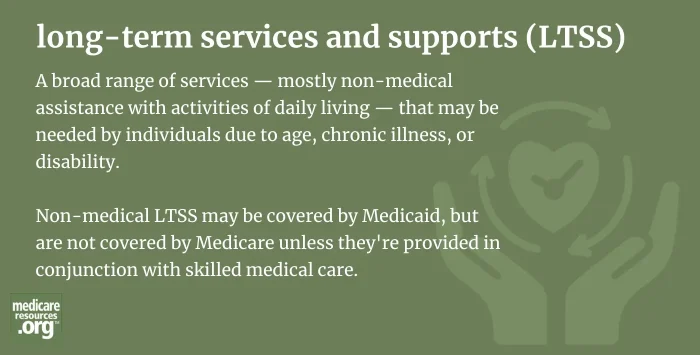
The term long-term services and supports (LTSS) encompasses an array of medical and personal care services for people who struggle with self-care due to aging, illness or disability. People commonly receive LTSS services for months or even years (and this is why LTSS are sometimes referred to as “long-term care”).

Lower-income Medicare beneficiaries may receive financial assistance through Medicare’s Extra Help program. If you have difficulty paying for prescriptions, the Extra Help program can make prescriptions more affordable than they would be with Medicare Part D alone.
People with Medicare and Medicaid are known as dual eligibles – and account for about 20 percent of Medicare beneficiaries (12.1 million people). Learn how that status affects your coverage.
In 2016, an estimated 11.7 million Medicare beneficiaries – about 20 percent of all enrollees – were also enrolled in Medicaid and are known as dual-eligible beneficiaries or dual-eligibles. And while you might not hear that term often – or at all – it's worth your time to understand what it means to have both Medicare and Medicaid (especially if you or a loved one is part of the "Medicare-Medicaid" population).
The term long-term services and supports (LTSS) encompasses an array of medical and personal care services for people who struggle with self-care due to aging, illness or disability. People commonly receive LTSS services for months or even years (and this is why LTSS are sometimes referred to as “long-term care”).
Lower-income Medicare beneficiaries may receive financial assistance through Medicare’s Extra Help program. If you have difficulty paying for prescriptions, the Extra Help program can make prescriptions more affordable than they would be with Medicare Part D alone.
Footnotes

